Free tool · UK tax year 2026/27
Inside & Outside IR35 Take-Home Calculator (2026/27)
Working Inside IR35 (eg. through Worksome or an umbrella), or Outside IR35 through your own limited company? This Inside and Outside IR35 calculator shows your real 2026/27 take-home pay, built on the same numbers Worksome uses to run actual contractor payroll and reviewed by our compliance team.
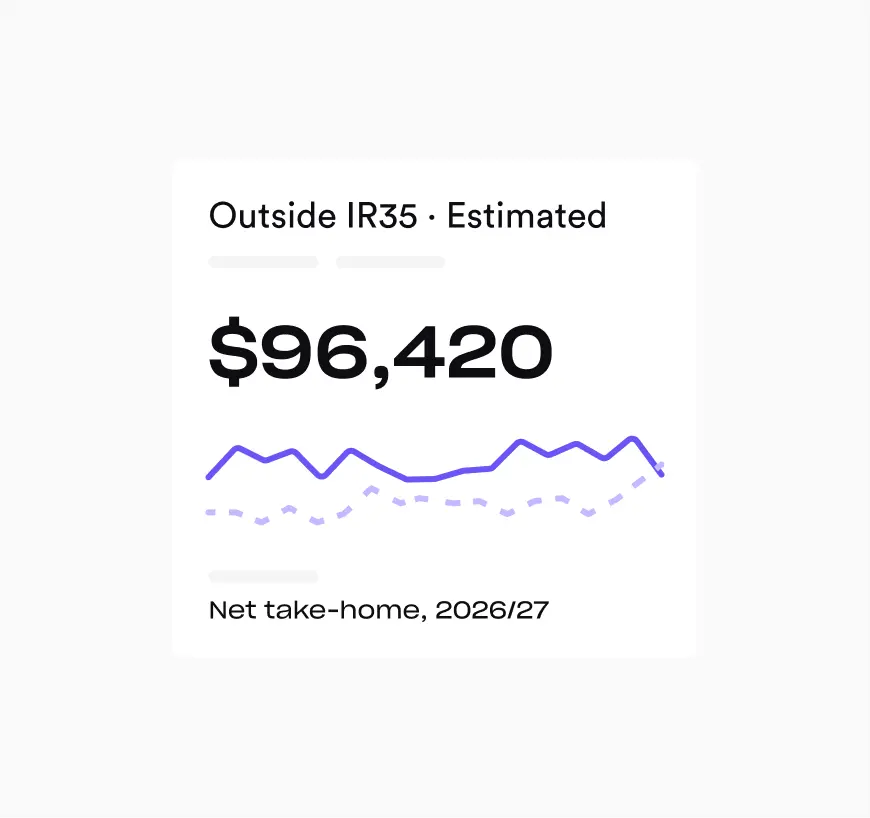







Find your IR35 take-home in
60 seconds.
Detailed comparison of tax liabilities for the 2026/27 tax year

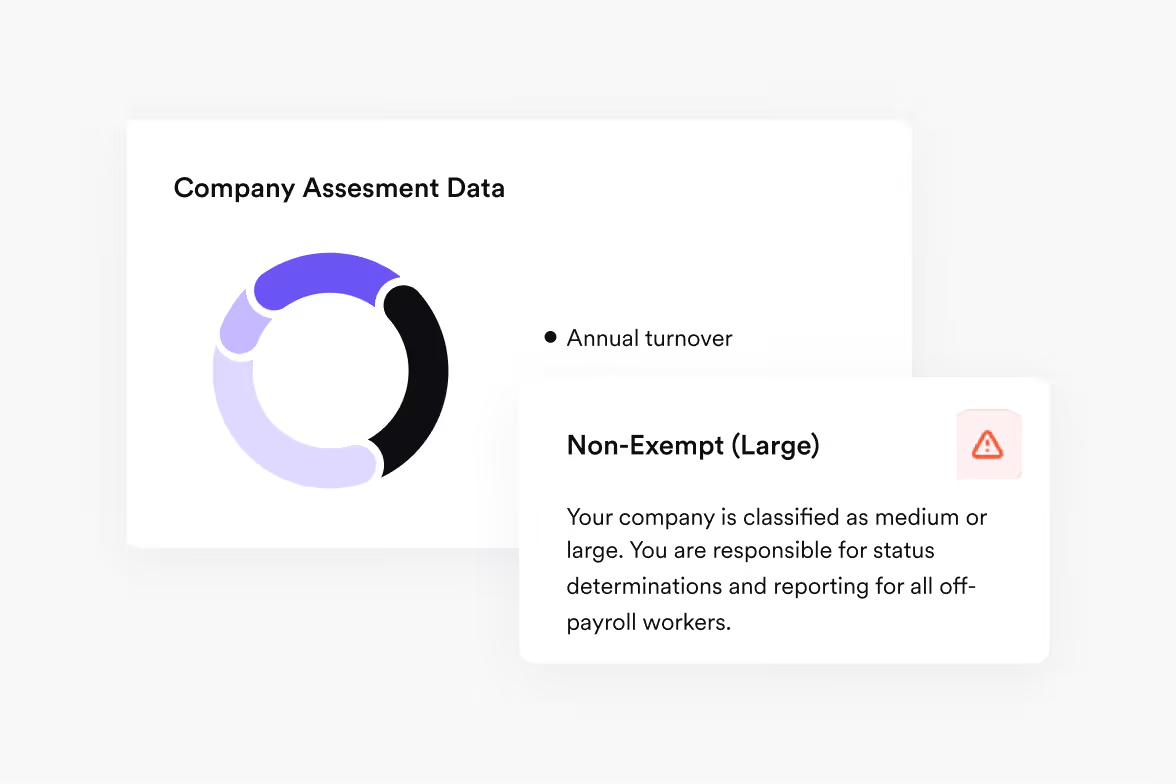
If your business was classed as small, the off-payroll working rules do not apply to you for the relevant tax year. Responsibility for IR35 status remains with the contractor’s intermediary. If you were medium or large, you are responsible for assessing IR35 status and meeting compliance obligations.
This is a free Inside IR35 calculator and Outside IR35 calculator for the 2026/27 UK tax year. If you work Inside IR35, it doubles as an umbrella take-home pay calculator: enter your day rate and see your net pay after PAYE, Employee NI and umbrella deductions. If you work Outside IR35, it acts as a contractor take-home pay calculator for your limited company, modelling salary, dividends and corporation tax. The Inside IR35 figures match the Worksome Key Information Document format exactly. Built by Worksome, named a Leader in the Everest Group FEMS PEAK Matrix 2026.
How to read your results
Three things to look at, in order. Everything else is detail you can drill into when you want it.


Plus: Annual Gross Distribution chart & Financial Breakdown table: Where every pound goes, line by line: under the results cards.
What this calculator actually does
This tool models two scenarios for the 2026/27 UK tax year. Inside IR35: you're paid PAYE as a deemed employee. Outside IR35: You contract through your own limited company and take a salary plus dividends. Whether you're contracting Inside IR35, Outside IR35, or weighing the two against a permanent salary, this calculator gives you the real take-home for each.
The Inside IR35 figures are formatted exactly like a Worksome Key Information Document: the legal payroll document we issue to every contractor we engage on payroll. Open the "Show Inside IR35 KID-format breakdown" panel under the results to see the same line items you'd see on day one of a real Worksome engagement.
Every rate that changed this year
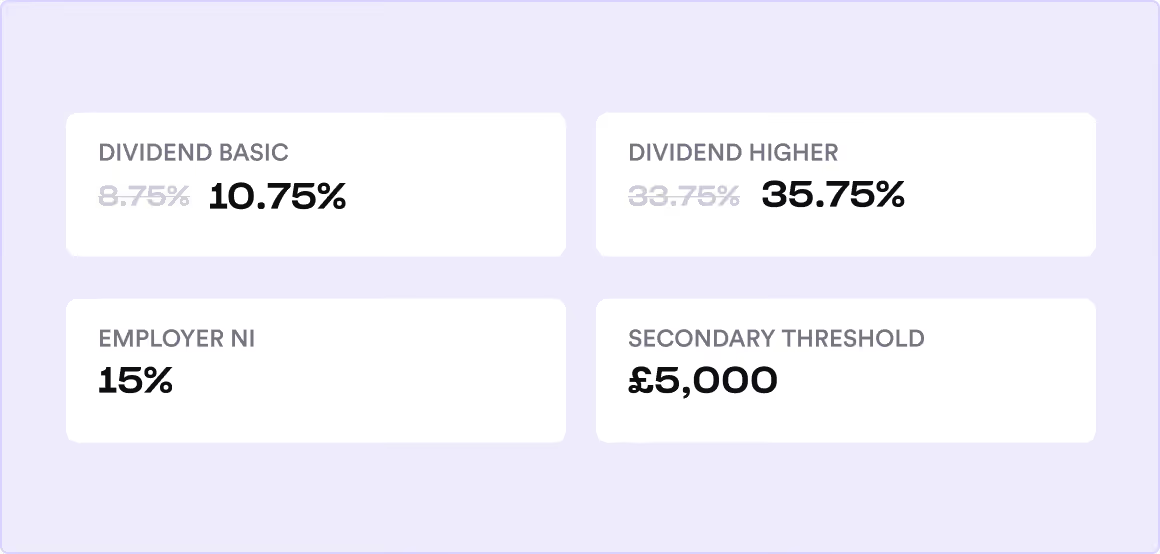
Built on HMRC's actual 2026/27 rates: not last year's, not flat approximations. New dividend tax rates, the 15% Employer NI introduced in April 2025, corporation tax marginal relief between £50k and £250k, widened Scottish bands from January 2026, the 4% EV BIK rate, and Plan 1/2/4/5/Postgraduate student loan thresholds.

Inside or Outside IR35? Find out in few minutes.
Use the calculator to size the gap. Then confirm your status with our free checker.
decision logicInside IR35 vs Outside IR35:
what's the difference?
what's the difference?
Inside IR35 means HMRC treats you as a deemed employee, so your day rate is taxed through PAYE before it reaches you. Outside IR35 means you work through your own limited company and take a small salary plus dividends, which usually leaves you with more of your day rate but puts the compliance risk on you. The calculator above shows the exact take-home gap on your rate.
- PAYE · UmbrellaInside IR35
Deemed employee, taxed at source
HMRC treats you as an employee of the client. Your day rate runs through an umbrella before it reaches you.  PAYE income tax and Employee NI deducted at sourceEmployer NI (15%), Apprenticeship Levy and umbrella fee come off the topHoliday pay rolled in at 10.77% of the booking feeSimpler admin: no accountant, no Self AssessmentLess room to optimise: no dividends, no expense flexibility
Best forEngagements your client has determined as inside, or short-term work where the admin of a Ltd isn't worth it.- Ltd · Salary + DividendsOutside IR35
Genuine self-employment
via your LtdYou contract through your own limited company: small salary, the rest as dividends after corporation tax. - Pay 19–25% corporation tax (marginal relief in scope), then dividendsSmall director salary at £5,000 or £12,570 to stay tax-efficientExpense, pension, and partner-dividend optimisations availableFlat Rate VAT surplus + EV BIK at 4% if eligibleYou carry the IR35 compliance risk if HMRC challenges status
Best forLong-term engagements with genuine substitution, control and financial risk: and where the accounting overhead pays for itself.
Methodology & Sources
Every parameter the calculator uses, every assumption, every rate, every HMRC source. The audit trail for accountants, journalists, and anyone double-checking the maths.




Frequently Asked Questions about IR35 take home calculator
2026/27 — the UK tax year running 6 April 2026 to 5 April 2027. It applies the rates and thresholds confirmed by the Autumn 2025 Budget, the Scottish Budget of January 2026, and HMRC publications dated up to April 2026.
No. IR35 status is a legal and contractual question, not a numerical one. Use HMRC's CEST tool or Worksome's IR35 status checker to determine status. This calculator only shows the financial outcome once status is decided.
The 2026/27 rates are 19% on profits up to £50,000, 25% on profits above £250,000, and a marginal relief band in between. The formula in the marginal band is: tax = profits × 25% − (£250,000 − profits) × 3/200. On £130,000 of profit this gives £30,700 — a flat-25% calculator over-taxes by £1,800, a flat-19% calculator under-taxes by £6,000. Most popular calculators get this wrong; ours doesn't.
Basic rate dividends: 10.75% (up from 8.75% in 2025/26). Higher rate dividends: 35.75% (up from 33.75%). Additional rate: 39.35% (unchanged). The £500 dividend allowance still applies. These changes were announced in the Autumn 2025 Budget.
Yes. Scotland has six income tax bands for 2026/27 — Starter (19%), Basic (20%), Intermediate (21%), Higher (42%), Advanced (45%), Top (48%). Bands were widened in the Scottish Budget of January 2026. Scottish rates apply to non-dividend income only — dividends are taxed at UK rates regardless of Scottish residency.
Limited company directors typically take a small salary (£5,000 — at the National Insurance Secondary Threshold — or £12,570, the personal allowance) and the rest as dividends. This is more tax-efficient than taking everything as salary, because dividends aren't subject to National Insurance and benefit from a £500 dividend allowance.
Yes — if your spouse or civil partner holds ordinary shares in your limited company, dividends can be split between you. The calculator's partner dividend split feature models this, including the partner's other income to find the optimal stacking point. Each partner gets their own personal allowance, dividend allowance, and basic-rate band, which can substantially reduce household tax.
If your annual VAT-inclusive turnover is between £85,000 and £230,000, the Flat Rate Scheme can leave a small surplus. Most IT and knowledge contractors qualify as Limited Cost Traders, paying a 16.5% flat rate to HMRC on VAT-inclusive turnover while charging clients 20%. The surplus on £144,000 of net billing is roughly £288 — small but real, and the calculator includes it in available company funds.
Outside IR35: employer pension contributions paid from your limited company are deductible from corporation tax — every £1,000 contributed saves £190–£265 in CT depending on profit band. Inside IR35: auto-enrolment minimums are 5% employee + 3% employer, with 20% basic-rate tax relief at source on the employee portion. The calculator defaults to these auto-enrolment minimums for Inside IR35 to match the Key Information Document format.
Expenses must pass HMRC's "wholly and exclusively" test. Allowable: accountancy and payroll fees, business software and subscriptions, business travel and subsistence, training relevant to your trade, professional indemnity insurance, home office (HMRC simplified rate or proportional), equipment under capital allowance rules. Not allowable: client entertainment, personal expenses, dual-purpose items.
Yes. All five plans are modelled with their 2026/27 thresholds: Plan 1 (£26,900), Plan 2 (£29,385), Plan 4 Scottish (£33,795), Plan 5 (£25,000), Postgraduate (£21,000 at 6%). For limited company directors, student loan is calculated on total income — salary plus dividends above the threshold — per Self Assessment rules.
If you're working through an umbrella that charges a weekly margin, enter it in the "Pay for an umbrella?" field. The fee is deducted from the billing pool before the umbrella math runs — exactly how it's processed on a real Worksome KID. Worksome itself does not charge a service fee on umbrella engagements; the field exists so contractors using third-party umbrellas can model their actual situation